


Calcium and Magnesium in a Reef Aquarium: One System, Two Numbers
Most reefkeepers learn early that corals need calcium and alkalinity for skeleton growth. Magnesium is usually “the third number” on the test kit – important, but often treated as an afterthought. In reality, calcium and magnesium are tightly connected. How you manage one directly affects how the other behaves.
That’s why you’ll sometimes see strange things happen in a reef tank:
- You try to raise calcium, but it barely moves until you correct magnesium first.
- Calcium and magnesium seem to move in opposite directions on your charts.
- You go from not dosing to using a balanced system like Hydroshock… and your calcium and magnesium levels actually drop at first.
This article walks through why that happens, how calcium and magnesium really interact inside a reef, and how to use Hydroshock along with Calcium²⁰+ and Magnesium¹²+ to correct and maintain a stable, natural seawater balance.
What Calcium and Magnesium Are Really Doing
Coral skeletons are often described as “calcium carbonate,” but that’s only part of the story. They’re closer to a reinforced mineral composite built from multiple ions working together.
- Calcium (Ca) – Primary building block of SPS and LPS skeletons. Along with carbonate and bicarbonate (alkalinity), it forms the aragonite structure that gives corals rigidity and growth tips.
- Magnesium (Mg) – Both a supporting ion in seawater and a structural component in coral skeletons. Magnesium is concentrated at sites of calcification (corallites), where it layers through and over calcium, strengthening the skeleton and helping to control crystal formation.
In natural seawater, typical ranges are:
- Calcium: ~400–450 ppm
- Magnesium: ~1,280–1,350 ppm
That “3× higher” magnesium level is not random. It’s part of what allows seawater to hold a lot of calcium and alkalinity without instantly turning into a snowstorm of precipitation. Magnesium helps keep calcium and carbonate in solution long enough for corals to use them.
Why You Often Have to Move Magnesium Before Calcium
A very common pattern we see in reef tanks and on our coral farm looks like this:
“I keep dosing calcium and alkalinity, but my numbers either won’t stay up or bounce all over the place.”
In many of those systems, magnesium has been quietly drifting down for months. When magnesium is low:
- Calcium and alkalinity are more likely to lock up as scale on heaters, pumps, and sand.
- The tank has a harder time keeping calcium and carbonate dissolved long enough for corals to use them.
- SPS and LPS may develop thin, weak bases and slower growth.
If you keep pushing calcium and alkalinity while magnesium is low, you’re fighting the chemistry instead of working with it. The smarter order of operations is:
- Test all three: calcium, alkalinity, and magnesium.
- Correct magnesium first if it’s below the natural seawater range.
- Once magnesium is stable, fine-tune calcium and alkalinity and then move into a balanced maintenance schedule.
Think of magnesium as the foundation. If the foundation is crooked, stacking more calcium on top won’t fix it – it just gives you a taller, crooked wall.
How to Correct Magnesium Safely
When magnesium is significantly low, a dedicated correction formula is the right tool. That’s where Magnesium¹²+ comes in.
- 1 mL per 1 US gallon raises magnesium by ~+10 ppm.
- Pure magnesium formula without extra trace ions.
- Ideal for increases of up to 50–100 ppm per day, with retesting between adjustments.
Once magnesium is back in the 1,280–1,350 ppm range, you transition to Hydroshock Magnesium (Part 3) as part of the full 3-part system for daily balance instead of correction.
When Calcium and Magnesium Look Inversely Related
On paper, calcium and magnesium don’t have to move opposite each other. In real tanks, though, reefers often see exactly that:
- “I raised magnesium, and my calcium reading dropped.”
- “My salt mix runs high Mg, so magnesium creeps up while calcium slowly fades.”
There are a few reasons this “see-saw” effect shows up.
1. Different Consumption Rates
Corals, clams, and coralline algae burn through calcium and alkalinity quickly when conditions are good. Magnesium is also used, but more slowly. If you’ve been running low magnesium for a while, coral growth is often throttled, and calcium consumption is lower than it should be.
When you correct magnesium:
- Magnesium jumps into its proper range.
- Corals now have the chemical environment they need for stronger calcification.
- Calcium and alkalinity consumption increase as skeletons thicken and growth accelerates.
On your tests, that looks like magnesium stabilizing while calcium trends downward – not because magnesium “stole” anything, but because your reef is finally using calcium properly.
2. Salt Mix + Water Change Bias
If your salt mix has slightly elevated magnesium but only moderate calcium, repeated water changes can slowly push Mg up while Ca drifts down, especially in high-demand systems.
- Water changes nudge magnesium higher.
- Corals consume calcium and alkalinity faster than they’re replaced.
The graph ends up looking like an inverse relationship, when it’s really your salt profile plus coral demand layered on top of each other.
3. Cleaning Up After a Low-Mg Period
In low-magnesium systems, extra calcium and alkalinity you dosed in the past may already have precipitated as scale on equipment and rock. Once magnesium is corrected:
- New precipitation slows way down.
- Corals redirect more of that chemistry into actual skeleton.
The tank stops wasting calcium on surfaces and starts using it in growth. Until you adjust your dosing to match this new demand, calcium may slide while magnesium holds steady.
Why Levels Can Drop When You Start Dosing Hydroshock
One of the most confusing moments for reefkeepers is this:
You go from not dosing at all to running Hydroshock 3-Part… and your calcium and magnesium readings drop instead of go up.
Here’s what’s actually happening in many tanks:
-
Before Hydroshock:
Calcium, alkalinity, or magnesium (or all three) have been drifting. Corals are alive, but growth is limited. Consumption is lower than it could be, because the chemistry is holding them back. -
You start dosing Hydroshock 3-Part in a 1:1:1 ratio:
Now the tank sees consistent daily input of calcium, alkalinity, magnesium, boron, potassium, iodine, strontium, and key trace metals in balanced amounts. -
Coral demand wakes up:
With stable chemistry and trace support, corals respond by growing more. That means they start pulling calcium and magnesium out of the water faster than before.
For a short time, your tank may be using more than you’re adding. Your Hydroshock dosage is matched to the “old” lazy reef, not the more active one you just created. On your tests, that looks like:
- Calcium: flat or drifting down.
- Magnesium: maybe up slightly, then returning to where it started or dipping.
It feels like dosing isn’t working – but in reality, it’s working perfectly. You’ve triggered increased growth and consumption. The next step is simply to increase your daily Hydroshock dosage until it matches the new demand.
How to Ride Out the Ramp-Up Phase
- Start Hydroshock at 1 mL per 100 L daily of each part (Calcium, Alkalinity, Magnesium).
- Test calcium, alkalinity, and magnesium every day or every other day.
- If levels are still drifting down, increase all three parts slowly and equally, keeping the 1:1:1 ratio.
- If one parameter drifts more than the others (for example, Ca lags behind), temporarily adjust that part alone, then return to equal dosing once it’s back in line.
Once your daily Hydroshock dose truly matches what the tank uses in 24 hours, those lines stop drifting and settle into stable, predictable trends.
Using Hydroshock with Calcium²⁰+ and Magnesium¹²+
Hydroshock is designed as a daily foundation system that prevents long-term imbalances, while Calcium²⁰+ and Magnesium¹²+ are single-parameter correction tools for when one number has fallen far behind.
Step 1 – Correct Out-of-Range Values
-
If magnesium is low:
Use Magnesium¹²+ to raise levels safely (1 mL per 1 US gallon ≈ +10 ppm). Don’t increase by more than 50–100 ppm per day. -
If calcium is low:
Use Calcium²⁰+ to raise Ca (1 mL per 1 US gallon ≈ +25 ppm). Don’t increase by more than ~50 ppm per day.
Once calcium is in the 400–450 ppm range and magnesium is in the 1,280–1,350 ppm range, it’s time to move away from single-parameter correction and into balanced maintenance.
Step 2 – Switch to Hydroshock 3-Part for Daily Stability
After correction, transition to the Hydroshock 3-Part Complete System:
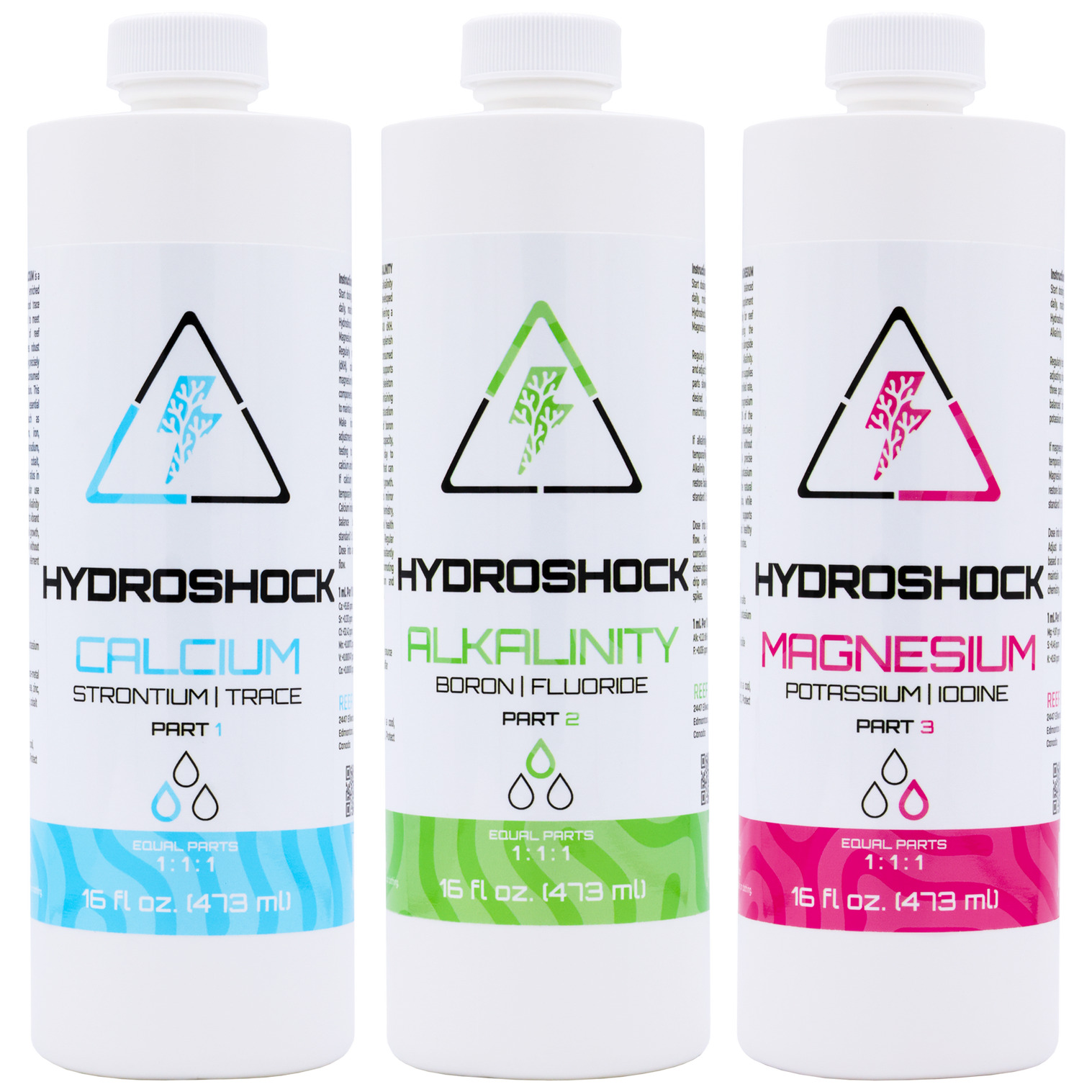
- Hydroshock Calcium (Part 1): Calcium, strontium, potassium, and trace metals (iron, manganese, zinc, vanadium) matched to coral skeletal ratios.
- Hydroshock Alkalinity (Part 2): 8,400 dKH total alkalinity with boron buffering to stabilize pH and reduce daily swings.
- Hydroshock Magnesium (Part 3): Magnesium, potassium, iodide, and sulfates to maintain the natural Na:Cl:S seawater ratio and soft-tissue health.
Begin at 1 mL per 100 L daily of each part in a 1:1:1 ratio, then tune up or down together based on how your tank’s calcium, alkalinity, and magnesium trend over time.
Target Ranges and What “Success” Looks Like
Every reef is unique, but many systems do well near these working ranges:
- Calcium (Ca): 400–450 ppm
- Magnesium (Mg): 1,280–1,350 ppm
- Alkalinity (Alk): 7.5–9.0 dKH (matching your salt mix)
More important than chasing a single “perfect” number is watching the trend:
- Small, gentle adjustments are safer than big corrections.
- Consistency beats perfection – 420 Ca and 1,330 Mg every day is better than bouncing between extremes.
- A short-term drop after starting Hydroshock can be a sign that your corals are using more, not that the product is failing.
Final Thoughts
Calcium and magnesium aren’t two separate fights – they’re parts of the same system. Magnesium sets the stage so calcium and alkalinity can behave, and corals respond to the overall balance, not just one test result in isolation.
By correcting out-of-range values with targeted tools like Calcium²⁰+ and Magnesium¹²+, then locking in daily stability with Hydroshock 3-Part, you give your reef the same kind of element-by-element balance found in natural seawater. The payoff shows up in thicker skeletal bases, stronger growth tips, better colour, and a reef that finally stops making you chase numbers.
Related Products
Hydroshock 3-Part Complete System
Balanced calcium, alkalinity, and magnesium with trace elements for daily reef dosing.

Hydroshock Calcium (Part 1)
Calcium, strontium, potassium, and trace metals tuned to coral skeletal ratios.

Hydroshock Alkalinity (Part 2)
High-capacity alkalinity with boron buffering for pH stability and strong skeletons.

Hydroshock Magnesium (Part 3)
Magnesium, potassium, and iodide to maintain ionic balance and soft-tissue health.

Magnesium¹²+
High-strength magnesium correction formula for safely restoring low Mg levels.

Calcium²⁰+
Concentrated single-parameter calcium for precise correction and maintenance.


