


At New Dawn Aquaculture, we do not chase random "perfect" numbers. We aim for stable, repeatable water chemistry that stays close to natural seawater and supports steady coral growth, healthy colouration, and predictable daily consumption. These are the working parameters we target on our coral farm, along with the ranges we consider workable in a healthy reef system.
These are the same products and target ranges we use on our coral farm every day. The goal is not complicated chemistry for its own sake. It is building a stable reef foundation that supports coral growth, colour, and long-term consistency.
If your reef is outside these ranges, the goal is not to make a huge correction all at once. Small, measured adjustments are safer than dramatic swings, and consistency almost always matters more than hitting one exact number on a single test.
Our Coral Farm Water Parameters
| Parameter | Our Farm Target | Workable Range |
|---|---|---|
| Temperature | 24-26°C (75-78°F) | 24-27°C (75-80°F) |
| Salinity | 35 ppt / 1.026 SG | 34-35 ppt / 1.025-1.026 SG |
| pH | 8.1-8.4 | 7.9-8.4 |
| Ammonia / Ammonium | Undetectable | Undetectable |
| Nitrite | Undetectable | Undetectable |
| Nitrate | 3-15 ppm | 2-20 ppm |
| Phosphate | 0.03-0.15 ppm | 0.02-0.15 ppm |
| Alkalinity | 8.0 dKH | 7.5-9.0 dKH |
| Calcium | 440 ppm | 400-450 ppm |
| Magnesium | 1320 ppm | 1280-1350 ppm |
Why Stability Matters More Than Perfection
Corals respond to trends, not just snapshots. A tank that stays close to the same temperature, salinity, alkalinity, calcium, and nutrient levels every day is usually healthier than a tank that constantly bounces between "good" and "bad" numbers.
That is why we focus on stable ranges instead of chasing isolated test results. If a parameter is slightly off but consistent, that is often easier to manage than a tank that is technically "in range" one day and swinging hard the next.
Temperature and Salinity
Temperature and salinity form the baseline for everything else. If either one drifts, every other test result becomes harder to interpret and corals have to spend energy adapting instead of growing.
Temperature
We keep our systems at 24-26°C (75-78°F). This is a comfortable range for most tropical reef livestock and helps support consistent metabolism, feeding response, and coral growth. More important than the exact number is avoiding sudden jumps from heater failure, hot rooms, or unstable controller settings.
Salinity
We target 35 ppt, which is about 1.026 specific gravity and close to natural seawater. Salinity that runs too low or too high changes osmotic balance, stresses fish and corals, and can skew calcium, magnesium, and alkalinity readings. We strongly prefer mixing with high-purity source water, which is one reason clean RO/DI water matters so much in reefkeeping.
If you want a deeper look at source water quality, our article Why Pure Water Matters is a useful companion read.
pH: Useful, But Best Read as a Pattern
pH is important, but it is also one of the most misunderstood reef parameters. In most established systems, pH changes throughout the day as photosynthesis and respiration shift carbon dioxide levels. A single handheld reading only shows one moment in that cycle.
We generally like to see pH land in the 8.1-8.4 range, but we care even more about the daily pattern than one isolated number. If you are troubleshooting low pH, continuous probe data over 24 hours is far more useful than occasional spot checks.
Nutrients: Measurable, Not Zero
On our coral farm, we do not aim for zero nitrate or zero phosphate in an established reef. Corals and their symbiotic algae still need available nutrients. The goal is to keep them present but controlled.
Ammonia and Nitrite
In a mature, cycled reef system, ammonia and nitrite should remain undetectable. If either one is showing up, that points to a filtration problem, an interrupted cycle, or a system that is carrying more biological load than it can currently process.
Nitrate and Phosphate
We usually prefer nitrate in the 3-15 ppm range and phosphate around 0.03-0.15 ppm. That gives corals access to nutrients without pushing the tank into the kind of imbalance that often drives nuisance algae, dull tissue, or unstable colour.
Numbers outside these ranges are not automatically a disaster, but the trend matters. If nitrate and phosphate are both falling to zero, corals can pale out and lose momentum. If both are climbing unchecked, the system often becomes less predictable and harder to manage.
The Big Three: Alkalinity, Calcium, and Magnesium
If temperature and salinity set the stage, alkalinity, calcium, and magnesium drive the actual chemistry of coral growth. These three parameters should be viewed as one system rather than three separate battles.
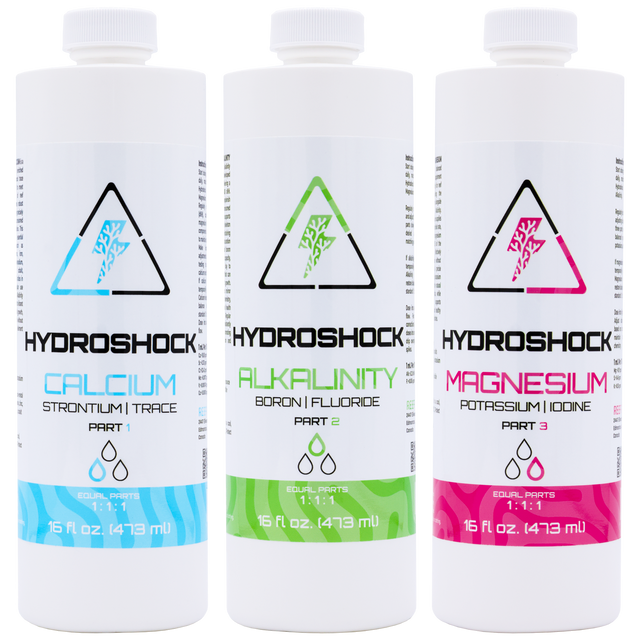
On our farm, the main products we use to support these parameters are the Hydroshock 3-Part Complete System and its three individual components: Hydroshock Calcium | Part 1, Hydroshock Alkalinity | Part 2, and Hydroshock Magnesium | Part 3.
Alkalinity
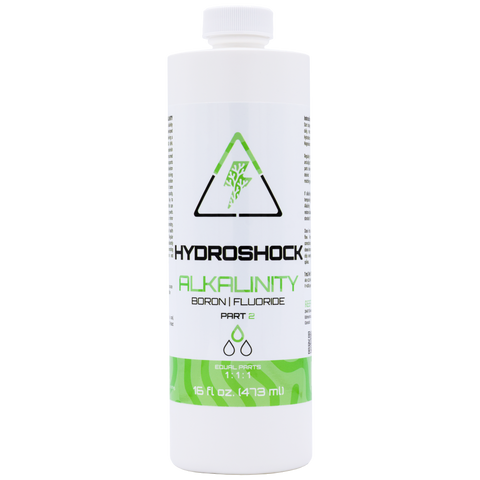
We target about 8.0 dKH and try to keep it stable. Alkalinity affects coral calcification directly, and it is often the first parameter to show instability in a growing reef. Fast rises and drops are usually harder on corals than simply running a little higher or lower than someone else’s preferred number. For day-to-day maintenance, we use Hydroshock Alkalinity | Part 2 as part of the full trio.
Calcium
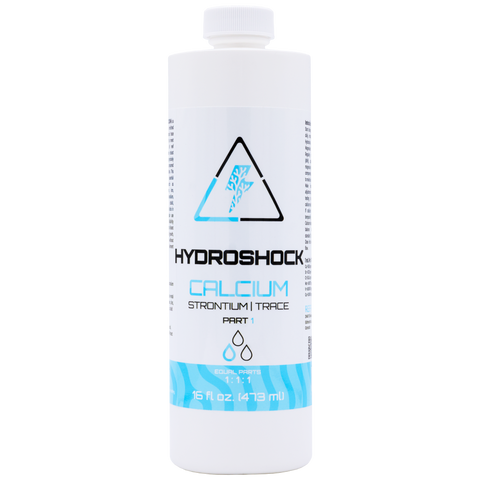
We target around 440 ppm calcium. This gives corals access to one of the main building blocks they need for skeleton formation. If calcium stays chronically low, growth slows, tips can weaken, and overall reef demand becomes harder to balance. Our standard maintenance product here is Hydroshock Calcium | Part 1.
Magnesium
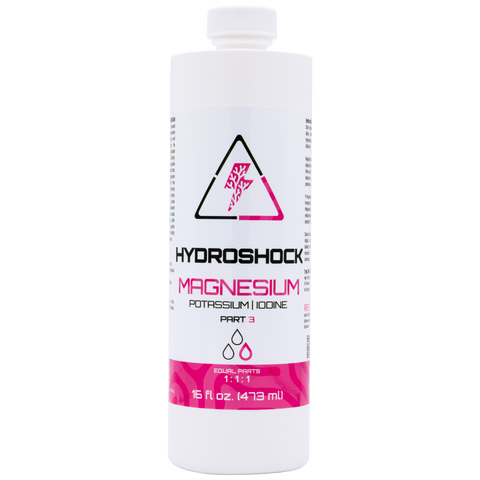
We target roughly 1320 ppm magnesium. Magnesium helps maintain ionic balance and makes it easier for the water to hold calcium and alkalinity in solution long enough for corals to use them effectively. When magnesium drifts too low, calcium and alkalinity often become harder to stabilize. We maintain that part of the system with Hydroshock Magnesium | Part 3.
For a deeper dive into how these parameters interact, see Calcium and Magnesium in a Reef Aquarium: One System, Two Numbers.
Trace Elements Come After the Foundation
Trace elements matter, but they are not the place to start if your reef is unstable. We care far more about getting salinity, alkalinity, calcium, magnesium, nitrate, and phosphate under control before worrying about small-element fine tuning.
Once the foundation is stable, balanced dosing and regular water changes make trace element management much more predictable. That is also where a consistent system such as Hydroshock 3-Part can make maintenance easier by supporting calcium, alkalinity, magnesium, and key trace inputs together instead of treating everything as a separate correction.
What We Use to Dose These Parameters
If you want to match the basic dosing foundation we use on the coral farm, start with the Hydroshock 3-Part Complete System. It is the simplest way to keep calcium, alkalinity, and magnesium moving together in a balanced 1:1:1 approach.
- Hydroshock 3-Part Complete System for the full balanced trio
- Hydroshock Calcium | Part 1 to maintain calcium and associated trace support
- Hydroshock Alkalinity | Part 2 to maintain carbonate alkalinity and pH stability
- Hydroshock Magnesium | Part 3 to maintain magnesium, sulfate, potassium, and iodide balance
For most reefkeepers, the bundle is the right place to begin. We only separate individual parts when we are fine-tuning a drift inside an otherwise balanced system.
How We Think About Testing
Testing is not just about collecting numbers. It is about learning what your reef consumes, how it responds, and whether your maintenance routine matches the biology of the tank.
- Daily or every other day: alkalinity when dialing in a new system or new dosing rate
- Several times per week: calcium and magnesium during correction phases
- Weekly: nitrate, phosphate, salinity, and temperature review
- Continuously when possible: pH and temperature through probes or controllers
If you are adjusting a dosing schedule, use trends over multiple tests instead of reacting to one reading. We built our dosing calculator to help make those corrections more deliberate.
Final Thoughts
These are the parameter ranges we trust on our coral farm because they are stable, practical, and proven in real systems. They are not meant to turn reefkeeping into number-chasing. They are meant to give you a reliable baseline.
Get the foundation stable, keep nutrients measurable, and make changes gradually. In most reef tanks, that approach solves more problems than chasing a new "ideal" number every week.


